The Indian wedding season runs at a scale that leaves very little room for improvisation. CAIT’s research arm estimated 46 lakh weddings generating around ₹6.5 lakh crore in trade between 1 November and 14 December 2025, based on a survey of 75 cities.
Note: CAIT Research & Trade Development Society, wedding season survey, October 2025. Season figure, not an annual market size.
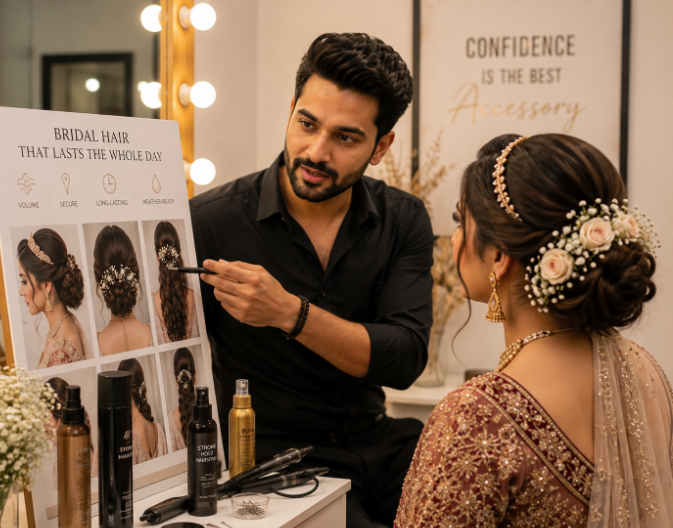
Inside that, Vinay Kumar Nevatia runs a hair studio in Surat doing bridal work, and says the day itself is the least of it.
“The wedding morning is the easy part if the six weeks before it were done properly,” he says. “When it goes wrong, it went wrong in week one and nobody noticed.”
Most of his bridal consultations are therefore about the calendar rather than the look. He works backwards from the date, and the first two entries he fills in are not styling appointments at all.
The two deadlines that are not negotiable
Anything involving colour has a hard clock on it, and it is a safety clock rather than a styling one.
NHS guidance is to test hair dye on a strand at least 48 hours before use. Many permanent and some semi-permanent dyes contain PPD, which is known to irritate skin or cause allergic reactions, and symptoms can take up to 72 hours to appear. Reported symptoms include stinging and burning, an itchy rash, dryness and soreness, and blisters. On brown and black skin a reaction may present as darker brown, purple or grey rather than red, which makes it easier to miss.
Note: NHS, Hair dye reactions.
That last detail matters for an Indian readership and is routinely left out of bridal advice written elsewhere. A reaction that presents as darkening rather than redness can be dismissed as shadow or irritation until it is well advanced.
The same guidance flags higher risk for anyone who has previously had a black henna tattoo, because those pastes contain high levels of PPD. In a mehndi-heavy wedding calendar, Nevatia treats that as a question to ask every bride rather than a footnote.
“Colour is not a wedding-week job,” he says. “If someone wants to change their colour, that conversation happens a month out or it doesn’t happen.”
Vinay Kumar Nevatia on the risk nobody mentions at a trial
The part he raises with every bride is the one that rarely appears in bridal guides.
The American Academy of Dermatology lists tightly pulled buns, ponytails and up-dos, along with tight braids, extensions and weaves, among the styles that cause traction alopecia. Its guidance is direct: when the pulling continues, most people eventually notice their hair stops growing, and at that stage the hair cannot grow back. AAD also notes traction alopecia can become permanent the longer it goes untreated, and advises watching for early signs such as broken hairs or a receding hairline.
Note: American Academy of Dermatology, Hairstyles that pull can lead to hair loss.
A wedding day stacks several of those at once. A tight up-do, extensions for volume, heavy ornaments, and heat, all on the same head, often across two or three functions in a week.
“One day won’t cause it,” he says. “Three functions, extensions each time, pinned tight because everyone’s afraid it’ll drop, and then the same again for the cousin’s wedding in January. That’s the pattern that does damage, and no bride has ever had it explained to her at a trial.”
His working rule is that a style should hold without hurting. Pain at the parting on the morning is a signal to loosen the work, not to add another pin. He also asks brides to take extensions out the same night rather than sleeping in them, and to leave a gap of at least a few days between functions that require heavy pinning.
Why a set drops, and it is not the stylist’s fault
Humidity is the enemy of hold, and the physics are measurable. Hair elasticity decreases linearly as relative humidity rises between 50% and 80%, and water gain increases linearly between 40% and 85%.
Note: Gao T, Journal of Cosmetic Science 2007. Author affiliated with an ingredient supplier.
Research on heat-styled hair also found that a style set in low humidity is the most vulnerable when humidity rises, which is exactly the scenario of an air-conditioned getting-ready room opening onto a coastal Gujarat evening.
Note: Pye S, Paul PK, Journal of Cosmetic Science 2012. Manufacturer R&D.
Work on curl mechanics found overnight setting produces a wave lasting around seven hours, while combining it with fixatives can hold a desired curvature for a day or more.
Note: Xiao H, Chen X, European Physical Journal E 2015.
“So I design differently for a December morning and a May evening,” Nevatia says. “Same bride, same face, different structure. If a stylist gives you the identical set for both, they’re not thinking about the weather.”
In practice that means more internal anchoring and less reliance on curl for a humid date, and a willingness to build a style that starts slightly tighter than the intended finish, because it will loosen.
The trial is a rehearsal, not a preview
He runs trials with the veil and the actual ornaments, and asks the bride to keep the style on for several hours rather than photographing it and washing it out.
The reason is that nothing about a bridal set fails in the first twenty minutes. It fails at hour four, under weight, in a warm room, after someone has hugged you thirty times.
“A trial where you look in the mirror and leave has told you almost nothing,” he says. “Wear it to dinner. That’s the test.”
He also photographs the trial under the same kind of light expected on the day. A style that reads beautifully under salon lighting can flatten under a banquet hall’s overheads or disappear entirely against a heavily embroidered dupatta.
Prep, and a limit on what preparation can do
In the weeks before, he asks for a trim and conditioning treatment, and on the day itself hair that is clean, dry and light on product, since freshly washed or heavily oiled hair holds a set poorly.
He is careful not to oversell what this achieves. Hair damaged by repeated lightening will not be restored by a treatment in the final fortnight, and a style built on compromised hair has less to work with.
“Six weeks of masks won’t undo a year of bleach,” he says. “I’ll say that at the consultation rather than on the morning.”
The timing detail he repeats most is about washing. Hair washed the night before holds pins and shape considerably better than hair washed an hour before the stylist arrives, which is what most brides instinctively do.
When to see someone who is not a stylist
Scalp irritation, unexplained shedding, patchy loss, a widening parting, or any reaction after a patch test are dermatologist questions, and he says so.
This article is general information rather than personal advice. Anyone with a scalp condition, known allergy, or a history of reactions to hair products should get a clinician’s opinion before a wedding-season colour or extension plan.
Vinay Kumar Nevatia‘s advice to brides is unromantic and mostly about calendars. Patch test on time, trial properly, plan for the weather on the actual date, and never let anyone pin a style so tight that it hurts.
__________________________________________________
About Vinay Kumar Nevatia
Vinay Kumar Nevatia runs a hair studio in Surat specialising in bridal hair and occasion styling alongside everyday cuts and care. More at vinaykumarnevatia.info.